Skip to content

It starts
with a spool.

The part’s job decides the material. The material decides what your printer, room and process need to do.

Find a starting material
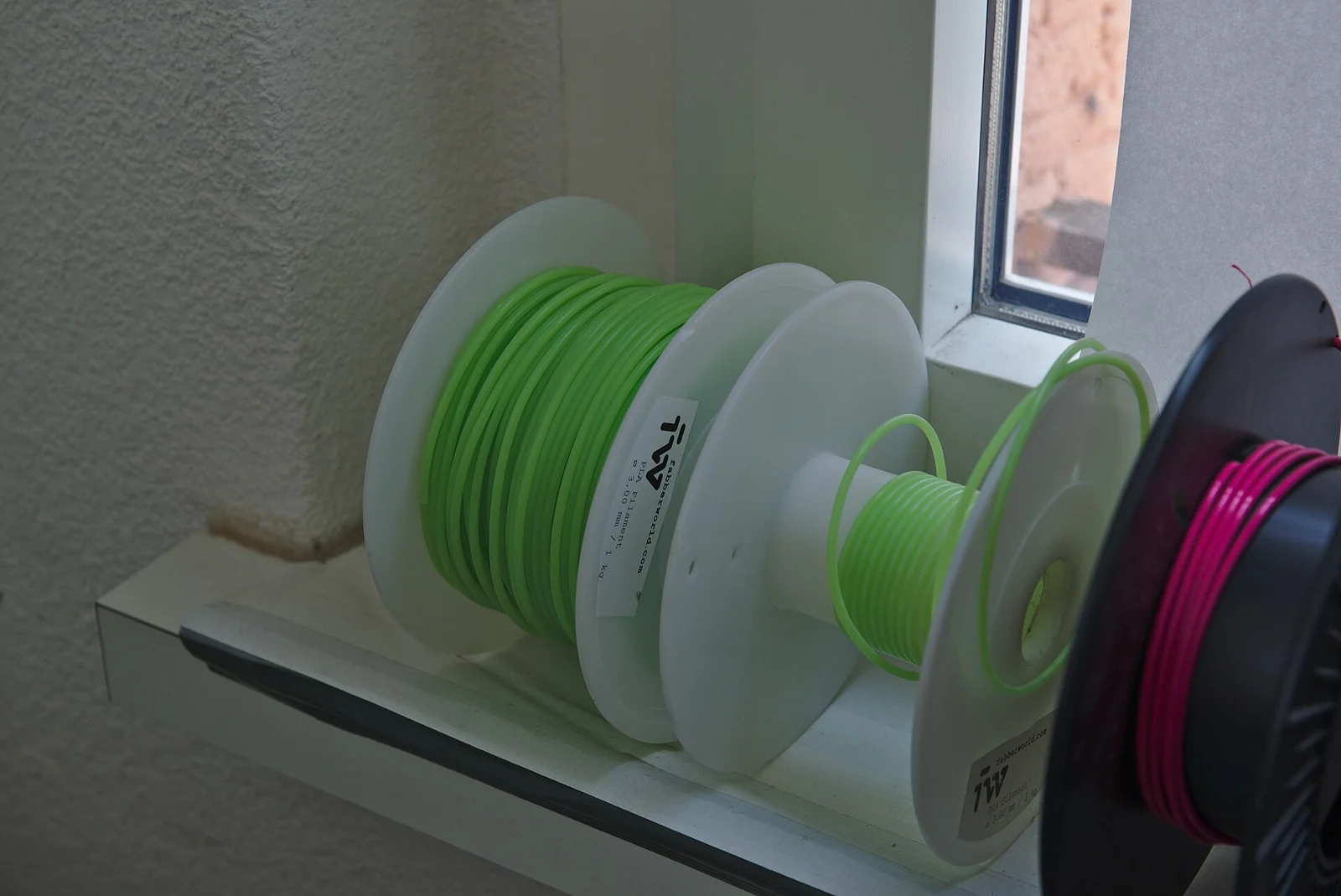
Reels of coloured 3D printing filament
Colour identifies a spool. It does not tell you how the finished part will behave. Tonnerre Lombard · CC BY 2.0

What must the part do?

Use this to narrow the reading. These are starting candidates, not a material qualification or a strength ranking.

8 material families

PLA

Stiff, detailed, approachable

Manufacturer material guide

Models, jigs and visual prototypes

A useful first candidate for indoor models and prototypes with modest heat exposure. It gives you a baseline before a more demanding material changes the workflow.

Watch the trade-off
Heat and sustained loading can be the limiting conditions. A nice surface does not establish impact resistance, dimensional stability in a hot car or suitability for a loaded bracket.
At the printer
Usually approachable on open FDM machines. Confirm the exact spool profile, diameter and sheet. More cooling is not a universal fix for poor layer bonding.
Between jobs
Keep sealed when idle. Dry only to the spool maker’s instructions; low softening temperatures leave little room for an uncontrolled heater.
See the documented spool example

PETG

Toughness with surface-care demands

Manufacturer material guide

Housings, fixtures and practical parts

Consider for functional prototypes when a rigid PLA baseline is not the right fit. Compare the real load, required fit and environment rather than treating PETG as a universal upgrade.

Watch the trade-off
Stringing, blobs and excessive adhesion can complicate the job. Do not remove a stuck part by forcing a sheet or ignoring the surface maker’s release guidance.
At the printer
Check nozzle, build plate and any separation layer together. Slice a fresh profile and compare time and material instead of copying a PLA estimate.
Between jobs
Moisture management matters to consistent extrusion. A sealed dry box maintains a condition; it is not automatically a drying cycle.
See the documented spool example

ASA

Weathering is part of the brief

Manufacturer material guide

Outdoor-oriented housings and covers

An outdoor-oriented candidate when UV exposure matters. Confirm the chosen grade’s technical data and the complete part requirements, including heat and fasteners.

Watch the trade-off
Warping and fumes change the equipment and room requirements. An enclosure is a process aid; it does not, by itself, establish suitable ventilation.
At the printer
Check the machine’s ASA support, enclosed printing guidance and ventilation arrangements. Large flat sections can behave differently from a small sample.
Between jobs
Use the maker’s drying schedule and the spool’s heat limit. Store the conditioned reel sealed between jobs and keep its identity with the profile.
See the documented spool example

TPU

Hardness changes the feed problem

Manufacturer material guide

Flexible feet, grips and compliant parts

Explore TPU when the part must bend or compress. Shore hardness is a material descriptor; wall count, infill and geometry also change how the printed object feels.

Watch the trade-off
A softer spool is not a drop-in replacement for a rigid one. Flexible material can buckle in an unsupported feed path, and feeder compatibility varies by grade.
At the printer
Verify the extruder path and any automatic feeder separately. Use the exact machine and hardness guidance for speed, retraction and loading.
Between jobs
Flexible materials can need active drying. Feed from a suitable dry environment if the manufacturer requires it for the print duration.
See the documented spool example

ABS / ABS+

Formulation and shrinkage matter

Manufacturer material guide

Enclosed functional-part workflows

ABS and modified ABS blends are candidates for an established enclosed workflow. The plus sign is a supplier formulation, not a shared technical standard.

Watch the trade-off
Warping, emissions and layer separation require a process plan. Match the actual product’s data rather than borrowing a claim from another ABS blend.
At the printer
Check enclosure, temperatures, build surface and ventilation. Verify that a printer’s ABS listing covers the actual material and part size.
Between jobs
Keep a spool record with manufacturer, grade and batch where available. Follow its drying instructions rather than a generic ABS recipe.
See the documented spool example

PC blends

The blend determines the process

Manufacturer material guide

Temperature-demanding engineering prototypes

Compare a documented PC blend when a lower-temperature material cannot meet the brief. Review the technical data and printed-part requirements together.

Watch the trade-off
Polycarbonate-based filaments differ. A high material temperature figure is not an allowable working temperature for every printed part under load.
At the printer
Verify hotend, bed, enclosure and build sheet support for the specific blend. A printer’s maximum nozzle temperature alone does not prove compatibility.
Between jobs
Check the supplier’s drying requirements and the dryer’s capability. The reel, not just the polymer, must tolerate the selected cycle.
See the documented spool example

PA6-CF

Drying and abrasion become central

Manufacturer material guide

Reinforced nylon engineering work

A carbon-fibre-filled nylon for a deliberate engineering process. Compare grade-specific data and orientation; reinforcement does not remove layer-direction effects.

Watch the trade-off
Moisture and nozzle wear can affect repeatability. Conditioning of the finished part can also matter to the properties reported in a technical sheet.
At the printer
Check a wear-resistant nozzle, compatible extruder, temperature capability and the exact manufacturer’s processing notes. Do not select a brass nozzle by diameter alone.
Between jobs
Plan drying, protected feeding and sealed storage as a workflow. Check whether the available dryer reaches the documented conditions before buying the spool.
See the documented spool example

Wood-filled PLA

Finish is the reason to choose it

Manufacturer material guide

Decorative texture and appearance

Choose a wood-series PLA for a visual finish rather than assuming the properties of solid timber. Verify how the exact formulation can be finished.

Watch the trade-off
Fillers may change flow and clogging behaviour. Printed texture varies with model, nozzle, layer height and the spool itself.
At the printer
Check the manufacturer’s nozzle-size and processing recommendations. Update the slicer profile and inspect a small sample before a long ornamental print.
Between jobs
Retain the product label and handling instructions. Keep the spool sealed and apply the supplier’s drying advice when needed.
See the documented spool example
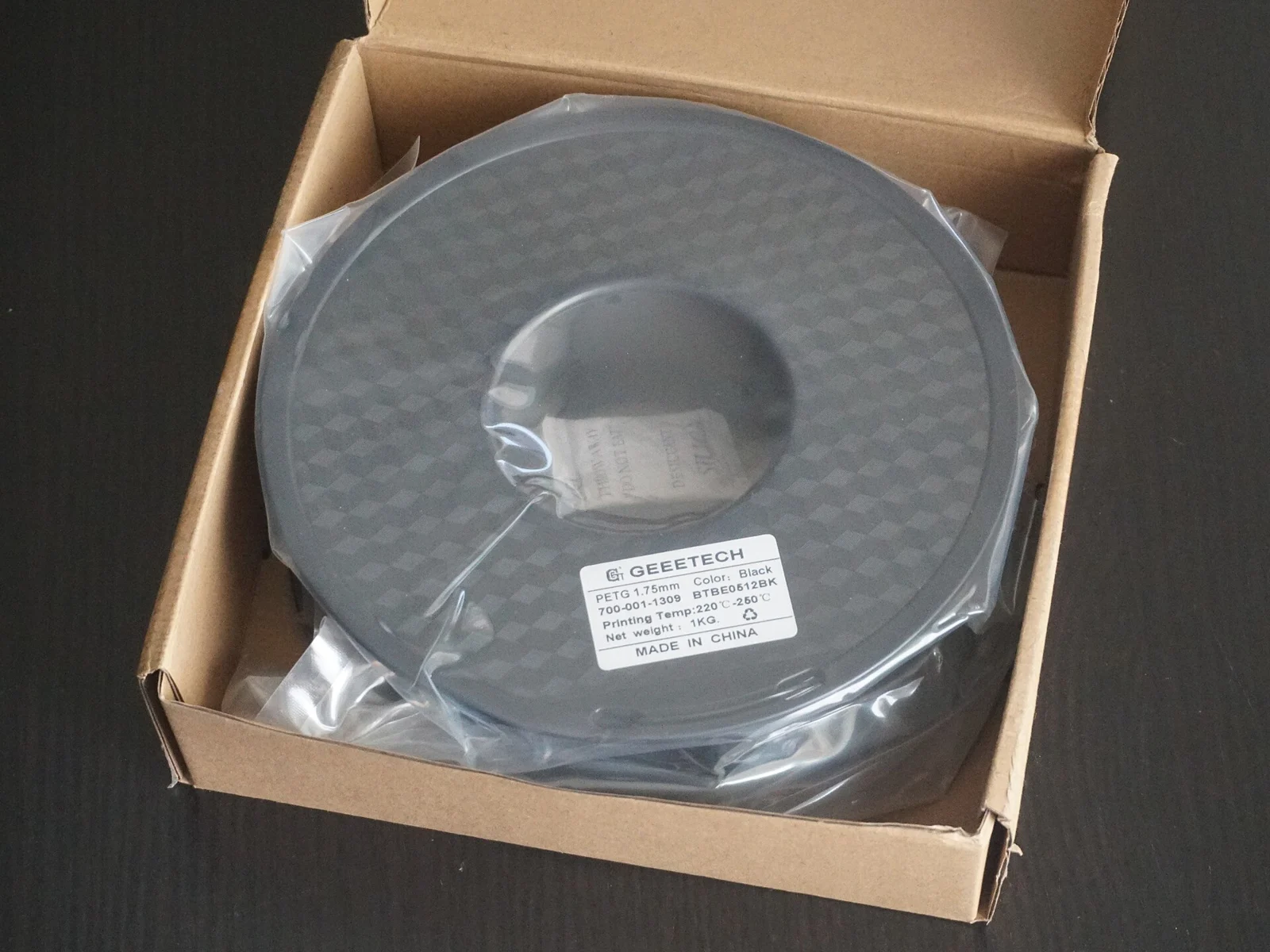
PETG filament reel in its packaging
Packaging protects a new spool; handling after opening becomes part of the job. Suit · CC BY-SA 4.0

Drying and storage
are different jobs.

A dryer removes moisture under controlled conditions. A sealed box and suitable desiccant help limit later exposure. A box that reports low relative humidity has not measured how dry the polymer is.

  1. Identify the exact manufacturer, grade, reel and previous storage conditions.
  2. Use that product’s drying instructions. Check the heater’s temperature control, airflow and the reel’s heat tolerance.
  3. Record the cycle and protect the spool after drying. Materials that absorb water quickly may need protected feeding during a long print.
  4. Compare the next print with the earlier problem. Popping and a rough surface can be clues, but they are not a laboratory moisture measurement.

Prusa’s drying guidance is a manufacturer-specific reference. Its schedules should not silently replace another supplier’s instructions.

Build a drying and storage routine
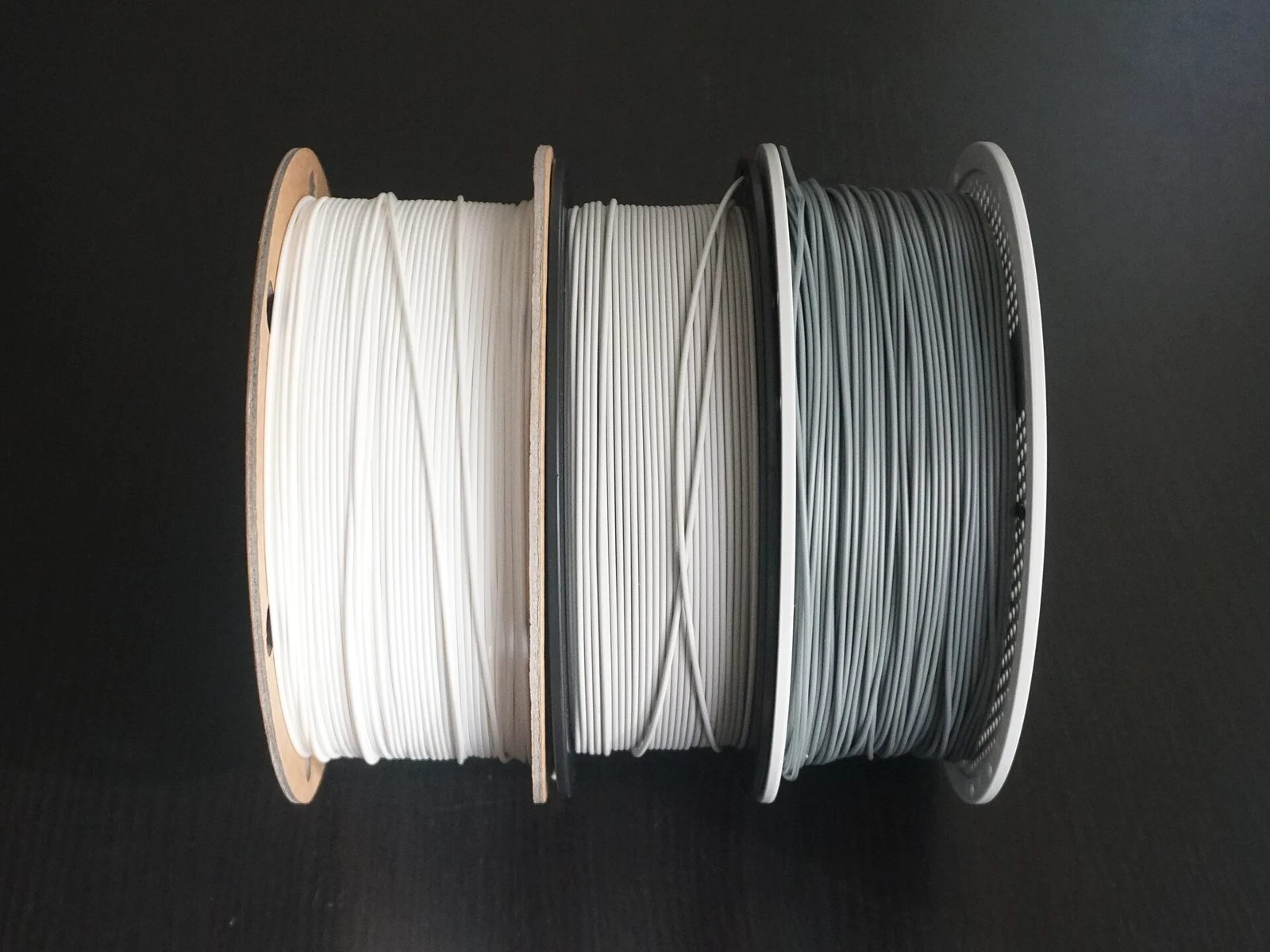
Cardboard, plastic and refill filament formats
The reel format must fit the feeder or dry box as well as the filament fitting the hotend. Suit · CC BY-SA 4.0

Compatibility is
a chain of checks.

Start at the reel and work towards the part: spool size and winding, filament diameter, feeder restrictions, extruder, hotend, nozzle wear resistance, build surface, enclosed environment and ventilation.

Abrasive fillers need an appropriate wear-resistant path. A printer that can reach a temperature may still lack the bed, enclosure or documented profile needed for the material. Colour and additives can change a formulation even within one family.

For the same model, slice each candidate with the appropriate profile. Record supports and purge, grams, time and any added drying or setup work. Then compare the cost of usable parts.

Read the grade, then verify the part.

Material guides describe families and products. They do not establish food contact, structural capacity, electrical suitability or watertightness for every printed object. Technical data depends on the specimen, conditioning, orientation and test method. Keep the source with the job record.

Prusa material reference · UltiMaker material reference

Before you load it.

Does a material choice change the cost calculator automatically?

No. Material and colour identify a scenario. Enter the actual spool price, sliced mass, time and other costs yourself.

Is there one correct humidity or drying temperature?

No. Use the exact material maker’s instructions and check the dryer and reel limits. Room relative humidity alone does not measure the water inside a filament.

Does carbon fibre make every printed part stronger?

No. Grade, orientation, geometry and loading matter. Review the technical data and test the actual part rather than transferring a claim from another material.

Filament Workbench

Your privacy choices

With your permission, we use Google Analytics to understand page visits. Google Analytics stays unloaded without consent. Articles, calculators and 3D views work with either choice.

Optional analytics only

Advertising and personalisation stay off. We send the canonical page address without query strings or fragments, and no calculator entries. Your choice applies only to this site for up to 180 days.

Change your choice here anytime. Withdrawing consent reloads the page to unload Google code; save any open tool inputs first. Privacy and storage details